Overview of Honzen-Ryōri (本膳料理)
Honzen-ryōri (本膳料理) had a major influence on the development of Cha-Kaiseki (tea kaiseki) and Kaiseki-Ryōri (kaiseki cuisine) However, few people, whether Japanese or foreign, know exactly what the term honzen-ryōri means. Below, we provide a detailed insight into this traditional form of Japanese cuisine.
An overview of three types of classic Japanese cuisine
Honzen cuisine (本膳料理)
Dishes served on a tray with legs, traditionally intended to entertain guests of samurai families.
Cha-Kaiseki (tea kaiseki)
Light dishes served during tea ceremonies. For more details about the order of courses and the contents of cha-kaiseki, please refer to the article on Sequence of courses in kaiseki.
Kaiseki cuisine (会席料理)
A seasonal multi-course menu where you can enjoy drinks in a convivial atmosphere. Our extensive series of articles explains more about Kaiseki.
Background of Honzen-Ryōri (本膳料理)
The Japanese custom of entertaining guests with sake and food dates back to the court cuisine of the Heian period (794–1185), known as Daikyō-Ryōri (大饗料理). This was a type of festive cuisine used by nobles and high-ranking officials at the imperial court to entertain the emperor.
This cuisine is characterized by a method of preparation in which great importance is attached to the cutting, proportions, and arrangement of the ingredients. The seasoning was very simple—salt, vinegar, Soy sauce – and should highlight the original flavor of the ingredients.
When the shogunate was moved from Kamakura to Muromachi (Kyoto) and samurai society began to have more contact with the court nobility, courtly Daikyō-Ryōri evolved into Honzen-Ryōri, which adopted the ceremonial elements and was adapted to suit the samurai.
Sequence of a Honzen-Ryōri menu
The form in which each guest is served a tray with legs is considered the prototype of today's Japanese cuisine. Anyone familiar with historical samurai films will surely have seen scenes in which individual, raised trays are placed in front of the guests. The number of dishes varies according to the rank of the guest.
Long banquets
Tradition has it that a honzen ryōri banquet could last all evening, accompanied by nō and kyōgen performances. Nō was a particularly popular form of entertainment among samurai during the Muromachi period (1336–1573).
Ritual: Shiki-Sankon (式三献)
The ceremonial part of Honzen-Ryōri begins with the sake ritual Shiki-Sankon (式三献). In three courses, a large, a medium, and a small sake cup are emptied:
- Course: Zōni (雑煮) – soup with mochi
- Dessert: Manjū (饅頭) – (usually) sweet filled pastries
- Course: Suimono (soup) – clear soup
„Shiki“ means „ceremony,“ „Sankon“ means „three cups (SakeOnly after this ritual does the actual meal begin.
Basic structure: Ichi-jū san-sai (one soup, three dishes)
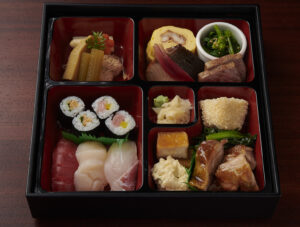
The basis of honzen-ryōri is a menu consisting of „one soup and three side dishes.“ The tray directly in front of the guest is called „honzen“ and includes rice, soup, pickles, namasu (膾), and a cooked dish. To the right of this is the Ni-no-zen (二の膳), which usually contains a grilled dish. Rice and pickles are not counted separately, so the three main dishes are the soup, namasu, cooked dish, and grilled „Hira (平)“.
Extension: from Ichi-no-zen (一の膳) to Go-no-zen (五の膳)
Depending on the size of the celebration, additional trays are added—for example, San-no-zen (三の膳), Yo-no-zen (与の膳; instead of 四の膳, because „four“ = „shi“ also means „death“) and Go-no-zen (五の膳). At the same time, the number of soups and side dishes increases to Ni-jū go-sai (二汁五菜; two soups, five side dishes) or San-jū nana-sai (三汁七菜; three soups, seven side dishes) and so on.
Example: Ni-jū go-sai (二汁五菜)
• The front tray (honzen) contains rice, pickles, namasu, and soup. Instead of „hira,“ there is another stewed or braised dish called tsubo (坪) on the right.
• The Ni-no-zen next to it contains another soup, a cooked dish, and a small choku (猪口) with a dressing or vinegar dish.
• Behind it is San-no-zen with a grilled course.
Example: San-jū nana-sai (三汁七菜)
• Honzen and Ni-no-zen correspond to Ni-jū go-sai (two soups, five side dishes).
• To the left of the Honzen is the San-no-zen, which includes an additional cooked dish, sashimi, and a third soup.
• After the Ni-no-zen comes the Yo-no-zen (grilled dish), followed by the Go-no-zen with the so-called Hikimono (引き物), a takeaway dish that is not eaten immediately. Often, the grilled dishes from the Yo-no-zen are also packed up and taken away.
Honzen-Ryōri originally began as a solemn military ritual for the samurai class, but gradually evolved into a lavish banquet. The banquets became longer and longer, and the number of courses steadily increased.
Honzen cuisine in the present day
Although Honzen-ryōri had a major influence on cha-kaiseki and kaiseki-ryōri, its importance declined sharply from the Meiji period (late 1860s) onwards due to increasing Westernization. After World War II, Honzen-ryōri was therefore only preserved in its traditional form in a few temples and old family homes.
Traces of Honzen-Ryōri in modern ceremonies
Even today, elements of Honzen-Ryōri can be seen at Shinto weddings, for example. The bride and groom drink three times from three different sized sake cups (large, medium, small) – called Sansan-Kudō (三々九度) – which is similar to Shiki-Sankon (式三献) in Honzen-Ryōri.
The custom of „hikidemono“ (party favors) at weddings corresponds to „hikimono (引き物)“ in Honzen-Ryōri. Even though many weddings today serve international cuisine, this principle of take-home food remains.
Okumizome (first solid food ceremony)
Another ceremony in which Honzen-Ryōri traditions are evident is Okumizome (お食い初め), which takes place 100 days after the birth of a child. The baby symbolically „eats“ for the first time to wish them a life without hunger. Here, too, the dishes are set up in front of the child in the same way as in Honzen-Ryōri.
Basic etiquette for Honzen-Ryōri
• After placing the honzen, the ni-no-zen follows.
• Lids of bowls and plates are placed on the side of the table.
• Do not eat the same food throughout the meal, but alternate between rice and side dishes.
• If you find it difficult to pick up food with chopsticks, pick up your plate.
• Once you have started eating a dish, you should finish it before moving on to the next one.
• When preparing a whole fish, remove the bones without turning the fish over.
• A small amount of rice is left over to be eaten with warm water and pickled vegetables (similar to ochazuke).
• Finally, the bowls are closed again with their lids.
• Sweets are accepted on a kaishi paper and shared with a toothpick.
• There is no chatting during the meal; discussions take place afterwards.
Many of these rules can still be found in modern Japanese table manners today. Although honzen-ryōri is rarely seen nowadays, its influence continues to shape everyday life and festive culture in Japan.
Sources and further links
- PLUS KYOTO TRAVEL
- Sadou Kaikan
- Adobe Stock: Kaiseki cuisine
- Rokusei – Kyoto
- Hyoki.jp Blog Nishiazabu
- Adobe Stock: Nō theater
- Adobe Stock: Sake cup
- Adobe Stock: Sansan-Kudō
- Adobe Stock: Hikidemono
- Adobe Stock: Okumizome
- Taiwa Kyoto Cooking School
- Kobayashi Foods
- Kyoto Prefecture
- Saijigoyomi
- Union of Kansai Governments
- Kyoto Uji mirage
- Kubotaya – Asahi Shuzō Magazine
- Oiwaizen