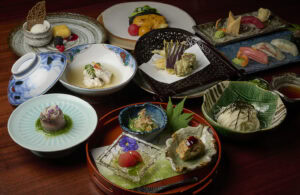
When the air outside is clear, the wind blows cool over the stones, and a fine mist settles over Munich in the morning, the time of 冬霞 – Fuyu-Gasumi: „winter fog“ begins for us at Sansaro.
Our new seasonal menu, available in 5 or 7 courses, pays homage to this very moment—to the quiet, warm antithesis of winter, to steam, broth, the aroma of rice, and the connection between Japan and Bavaria in the middle of the cold season.
Fuyu gasumiiwinter haze winter fog
In Japan, winter is a very unique culinary season:
Warming dashi broths, steamed dishes, root vegetables, winter spinach, seafood such as crab, scallops, and shrimp, accompanied by citrus fruits such as yuzu and mikan. Our winter menu, 冬霞 – Fuyu-Gasumi („Winter Mist“), attempts to capture this mood and combine it with some regional products from Bavaria.
Sakizuke 先附
Fuyu zensai sanshu 冬前菜三種 – Winter starter trio
Shika-tataki karashi su-miso soe 鹿肉たたき 辛子酢味噌添え – Venison tataki with karashi su-miso
Fuyu hōrensō goma ohitashi 冬ほうれん草胡麻お浸し – Winter spinach goma ohitashi
Renkon no karikari-age 蓮根のカリカリ揚げ – Crispy fried lotus root
Venison loin from mountain hunting as tataki, winter spinach as Ohitashi and crispy fried lotus root are reminiscent of Japanese winter cuisine, in which leafy vegetables and root vegetables play a major role.
Mushimono Steamed Food
Chawanmushi with scallops, red shrimp, and shiitake mushrooms
Chawanmushi—steamed egg custard with dashi—is a typical winter dish in Japan. This version combines scallops, red shrimp, and shiitake mushrooms, as found in winter nabe and nimono dishes. A subtle, warm dish that emphasizes the steamed side of the menu.
* Sashimi お造り
Hirame sashimi wrapped in turnip and served with Tosa vinegar jelly 平目昆布締め蕪包み土佐酢ジュレ添え
Hirame (flounder/plaice) is matured on kombu as kombujime 昆布締め – a classic technique from Kyoto and Kansai. The thin slices are wrapped in sweet and sour pickled kabu (small radish slices) like a flower and served on Tosa-zu jure, a vinegar and dashi mixture in jelly form. A winter sashimi that uses pickled vegetables and jelly instead of crunch.
Yakimono 焼物
Duck breast with red wine teriyaki sauce 鴨胸肉の赤ワイン照り焼き
Dishes featuring kamo (duck) are popular in Japan during the cooler months, such as kamo nabe or grilled kamo breast. Here, duck breast is cooked until pink and glazed with a red wine teriyaki sauce.
* Nimono simmered dishes
Golden sea bream with winter vegetables
Kinmedai (red snapper) is gently cooked in dashi and combined with various winter vegetables. In the form of takiawase 炊き合わせ, the components are each prepared appropriately and then served together—a very typical way of presenting winter vegetables and fish in kaiseki cuisine, and for us a typical Japanese highlight in this menu.
* Shokuji 食事
Steamed sushi
Steamed sushi rice bowl with crab, kanpyo, inari, and delicate kinshi tamago strips.
Tuna with mountain vegetables
Tuna cubes with grated nagaimo—a combination often served in Japan as a light accompaniment to rice.
Prawn Shinjo Roll with Saikyo Miso Soup 海老しんじょう巻きの西京味噌椀
Saikyō miso soup from Kyoto with a delicate ebi shinjō roll (shrimp stuffing).
Mushi-zushi, warm steamed sushi, is a winter specialty, especially in Kyoto. Together with maguro-yamakake and a special miso soup, it creates a shokuji that combines several classic winter motifs of Japanese cuisine: warm rice, neba-neba root vegetables, and light miso broth.
Kanmi 甘味
Mascarpone ice cream, matcha biscuit, and yuzu-mikan sauce
Finally, Japanese winter citrus fruits Yuzu and mikan みかん on matcha biscuit, mascarpone ice cream, and a cinnamon tuile. Citrus fruits play an important role in Japan in winter—both in the kitchen and in rituals—and form the fresh finale to the Fuyu-gasumi 冬霞 menu, our „winter mist“ in the Amalienpassage.
5 courses per person 100 euros — Accompanying beverages 40 euros
* 7 courses per person $120 — Accompanying beverages $50