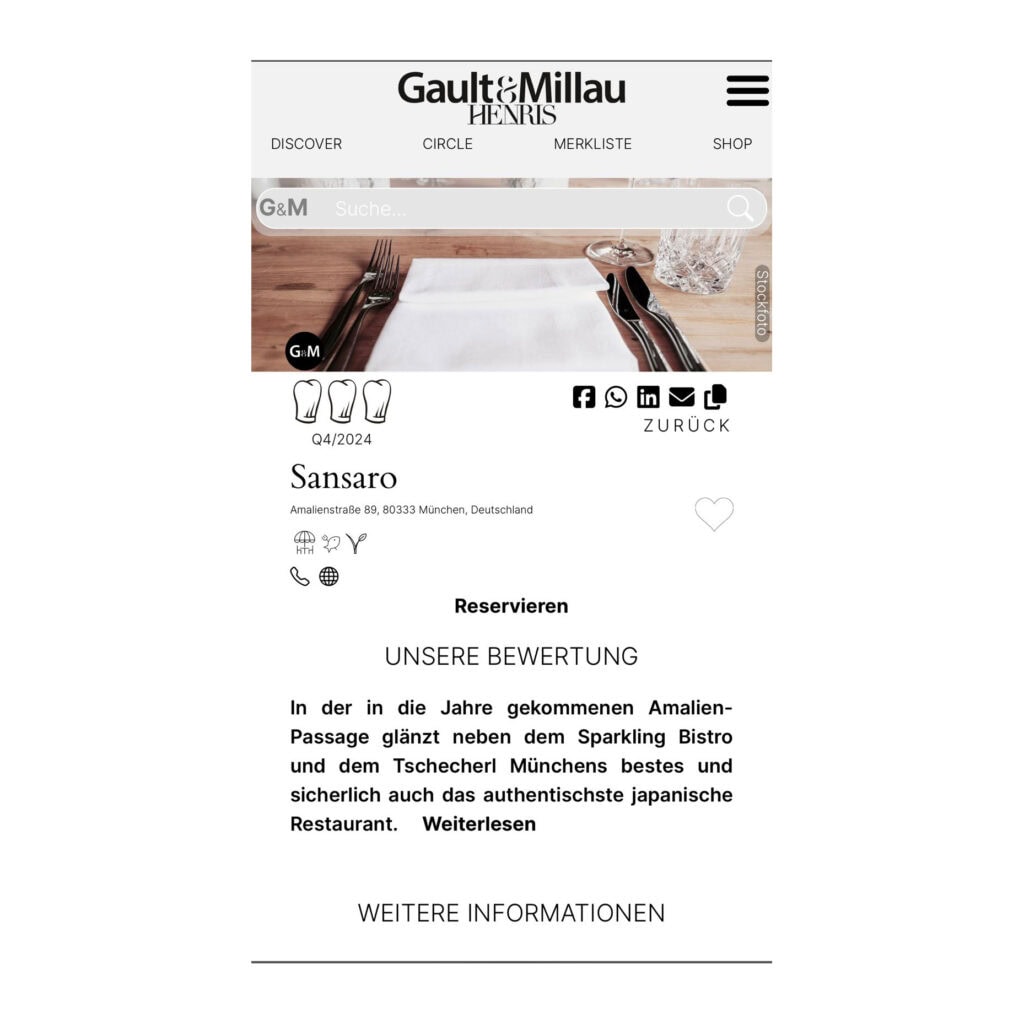
We are delighted that Gault&Millau has discovered our restaurant and that sansaro has been awarded three black hoods for 2025.
For our entire team, this is not only confirmation of our hard work and love of Japanese cuisine, but also an incentive to continuously develop our range and quality.

An important source of evaluation alongside the MICHELIN Guide
The Gault&Millau, Founded in France in 1969 by Henri Gault and Christian Millau, it is now one of the most influential restaurant guides in the world alongside the MICHELIN Guide. Emerging from a counter-movement to classic haute cuisine, it had a decisive influence on „nouvelle cuisine,“ which focused on freshness, product quality, and lighter preparation. Gault&Millau is now published not only in Europe, but is also established in North America, South America, and various regions of Asia.
Particularly in the European context, the Gault&Millau has been highly regarded for decades. Its own points system (0 to 20 points) and the resulting toques (up to 5 black toques and the rare red toques for culinary excellence) provide professional classifications for gourmets on the one hand, but also valuable guidance for curious connoisseurs on the other.
Reception of Gault&Millau in Japan
During the MICHELIN Guide already enjoying great popularity in Japan, Gault&Millau has been gaining increasing prominence there since its first edition in 2017.
Its editors strive to capture the regional diversity and unique characteristics of Japanese cuisine. Product quality, innovative spirit, and service culture play a central role in this endeavor.
Nevertheless, in the Japanese trade press, for example in articles in the Japan Times (October 22, 2018), Japan Times Archives), critically debated whether a „Western“ rating concept can fully do justice to the depth of Japanese cuisine. In Japan, there are restaurants with recipes that are sometimes centuries old and extremely strong regional ties. Some critics also complain that Gault&Millau has not yet gained as much trust there as Michelin or local review portals (e.g., Tabelog). This is, of course, the fundamental problem when the japanese cuisine outside Japan by people who sometimes have only a limited understanding of its depth and context. Nevertheless, many chefs, especially the younger, modern generation, see Gault&Millau as a refreshing alternative offering new perspectives.
3 toques for the sansaro in Munich
In this challenging environment, we are all the more pleased that we have three black hoods were awarded.
For us, this ranking does not mean that we have already reached the highest echelons of Gault&Millau – after all, the ratings go up to five black toques and even include red toques for particularly outstanding cuisine. Nevertheless, the result shows that our focus on:
- Top-quality ingredients (not only for fish, meat, rice, and vegetables, but also for less visible items such as flour, sauces, and small ingredients – We have been using organic or comparable products for years. wherever possible)
- Finely balanced flavors (We strive for an authentic Japanese taste profile rather than Eyewash Sushi)
- Respectful interpretations of traditional Japanese and modern international influences
receives valuable recognition.
It is precisely this combination of Japanese craftsmanship and local identity that is so important to our Restaurant sansaro essential.
However, we are particularly grateful for two almost casual remarks in the text: from the „best and certainly most authentic Japanese restaurant in Munich“ is there talk of – and of a „Exceptional restaurant“.
The latter in particular touches us deeply, because it seems as if the Gault & Millau testers are acknowledging the absurdly high level of effort we put in behind the scenes: we work almost scientifically to research Japanese cuisine and culture, translate it culturally and linguistically, and create it for our guests in the form of well-documented dishes that simply taste good, are made with the best possible ingredients, and are authentic to Japanese cuisine and seasonality.
If our guests simply enjoyed the food and the professional testers see the hard work and genuine enthusiasm for Japanese cuisine that goes into it, then we are happy and grateful!