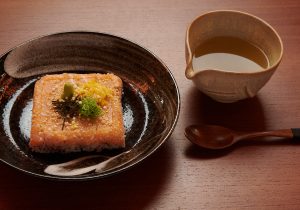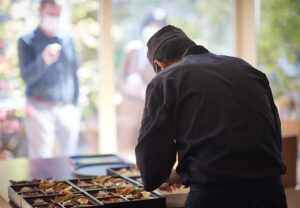
The art of presenting varied yet harmonious dishes in a multi-course menu is a demanding challenge. In Japan, the Kaiseki (会席) special appreciation; it is considered a culinary masterpiece in which every detail—ingredients, preparation, Tableware and presentation – are coordinated. French haute cuisine, on the other hand, is one of the most influential culinary traditions in Europe and beyond, characterized by refined sauces, complex flavors, and a structured sequence of courses.
French cuisine is considered the benchmark and structural framework, particularly in the MICHELIN Guide, but also by many Western chefs and gourmets. It is therefore important to understand and evaluate Japanese cuisine by being aware of the fundamental differences in course sequence, orientation, and objectives.
The following article presents and compares key elements of Japanese kaiseki and French haute cuisine. It shows how, despite their different cultural backgrounds and techniques, both styles share the same commitment to perfection, seasonality, and aesthetics—while at the same time pursuing very different culinary paths.
Origin and structure of kaiseki
Historical background
Culinary kaiseki (会席) has developed over many centuries and combines influences from various traditions such as court cuisine (Yūsoku-Ryōri), the Buddhist temple cuisine (Shōjin-Ryōri) and the gastronomic customs of samurai households (Honzen cuisine).
At its core is a radical shift toward the season: The ingredients should develop their characteristic flavors without being masked by excessive seasoning.
This „less is more“ philosophy is complemented by a special attention to detail. Everything that is served reflects a respect for the ingredients and nature—right down to the choice of tableware, which often features subtle references to the current season.
As a reminder: culinary kaiseki, a seasonal feast traditionally served with sake, is not—as is often mistakenly reported—originally a monk's meal or a dish that originated from the tea ceremony!
We have discussed the distinction between and historical development of the two forms of kaiseki in the article on History of Kaiseki explained.
Typical gait sequence
A kaiseki menu consists of several courses, the exact sequence of which can vary. However, the following structure is often found:
- Sakizuke (appetizer)
A small greeting from the kitchen, setting the mood for the theme. - Wan-mori (bowl dish) / Shiru-mono (soup dish)
A light, clear broth (dashi) with seasonal ingredients. - Mukōzuke (appetizer)
Sashimi course that highlights the freshness of the ingredients. - Yakimono (焼物)
Grilled food, usually fish or meat, with a focus on seasonal specialties. - Nimono-wan (simmered dish bowl) / Futa-mono (covered dish)
Steamed or boiled dishes served in a bowl with a lid. - Shii-zakana (strong side dish)
A fried, steamed, or pickled dish that adds new flavors. - Shokuji (meal)
Rice (often plain white rice), soup (e.g., miso shiru), and kō-no-mono (Japanese pickles) to round out the menu. - Mizu-gashi / Mizu-mono (water sweets / water items)
A light dessert or fruit to gently round off the meal.
This basic structure can be expanded depending on the chef, restaurant, or occasion by adding additional courses (e.g., a Hashi-yasume as a palate cleanser).
Further information can be found in our article on the Sequence of courses in kaiseki.
Haute cuisine (fine French cuisine)
Historical development
French haute cuisine has its roots in the royal court and the great houses of the nobility, where it was refined over centuries. Chefs such as Antonin Carême and Auguste Escoffier shaped complex techniques and sauces that are still an essential part of French cuisine Over time, a clear set of rules for the sequence of courses also emerged—an order that combines enjoyment, satiety, and culinary experience. increase successively should.
Typical gait sequence
The menu structure of haute cuisine can vary in modern fine dining restaurants, but classically, the following sequence is often found:
- amuse-bouche
A small greeting from the kitchen, served with an aperitif. - Entrée (starter)
Often a warm or cold specialty such as terrine, soup, or salad. - Poisson (fish course)
A light fish dish, often served with a delicate sauce so as not to be too filling. - Main course
Meat, poultry, or game with elaborate side dishes and sophisticated sauces. - Cheese platter
A tradition typical of France, enjoyed as a course in its own right. - Dessert
Often an elaborate, creative dessert that provides a fitting conclusion to the meal. - petit fours
Small sweet snacks, petit fours, or chocolates served with coffee or tea.
Intermediate courses such as the Trou Normand (a sorbet with Calvados) can be inserted to neutralize the palate and divide the menu into different phases.
Comparison between France and Japan
Dramaturgy and rhythm
Kaiseki is characterized by a harmonious, rather subtle progression and consistent balance. Each course fits into the overall concept without overpowering the previous one in terms of taste. In terms of seasoning, everything is reduced to the essentials in order to emphasize the natural flavor of the ingredients. Intense or bold flavors could be considered clumsy in kaiseki if they do not also include the possibility of „palate recovery.“.
On a culinary level, this corresponds to the Japanese pursuit of group harmony on a social level – and, incidentally, it fits in with the idea of Washoku as cuisine of harmony One: no single ingredient or course should dominate the entire menu.
French haute cuisine In contrast, it usually relies on a significant dramaturgy. Lighter starters lead into an intense main course, before cheese and dessert form the culinary „high point.“ Buttery and creamy elements as well as complex sauces are typical, giving the dishes a characteristic density and complexity. Like a symphony, where everything builds up to a dramatic crescendo.
Seasonality vs. complexity
Seasonality plays an important role in both cuisines. In kaiseki, however, this aspect is almost celebrated—from the tableware and decoration to the special ingredients of each season. The art lies in allowing the flavor of the ingredients to shine through by preparing them correctly and skillfully. Clarity and simplicity are paramount. However, as explained above, this simplicity does not come from the tea ceremony, but generally from the supposedly modest and reserved character of the people, especially those from Kyoto, where kaiseki has its spatial epicenter.
Seasonal products are also valued in French cuisine, but the emphasis is on artistic preparation and often rich flavor combinations. Creativity is evident in complex sauces, diverse textures, and contrasting combinations.
Desserts to finish off
Japanese approach
In kaiseki, dessert (often referred to as Mizu-gashi or water thing The sweet components are deliberately light, often fruit-based or in jelly form, sometimes also bean paste (anko). The idea is to give the palate a „friendly“ finish without overpowering the restrained flavor profile of the menu. Seasonality often plays a major role here as well—for example, in the form of seasonal fruits or delicate desserts that round off the theme of the menu.
French approach
In contrast, dessert often plays a prominent role in haute cuisine: an artfully decorated dessert can be the crowning glory of a meal, with elaborate techniques (e.g., soufflés, mousses, artistic cakes). Here, opulence is often indulged in – chocolate, cream, caramel, crispy pastry components, and aromatic sauces are frequently found in complex compositions. The chef's goal is not only to „refresh“ the guest, but also to impress them and create a lasting "wow" effect. In many fine dining restaurants, dessert is considered a creative playground where techniques, visuals, and a variety of flavors are once again showcased.
These contrasts also reflect the culinary backgrounds of the two cuisines: while kaiseki focuses on reduction and subtle nuances, French patisserie strives for aromatic opulence and a „grande finale.“.
Two great traditions
Although Japanese kaiseki cuisine and French haute cuisine originate from different cultural contexts, they share the basic idea of a harmonious, perfectly staged sequence of dishes. Both place great emphasis on the finest ingredients, meticulous presentation, and telling a culinary story—from the first small greeting from the kitchen to the sweet or refreshing finale.
The differences are particularly evident in the approaches: while kaiseki focuses on delicacy and the unadulterated character of the ingredients, French haute cuisine places more emphasis on complex preparations and sumptuous flavors. These philosophies are particularly evident in desserts: in Japan, they tend to be light and delicate, while in France, they can be a veritable explosion of flavor with chocolate, cream, and rich sauces.
What both cuisines have in common is that they want to take guests on a journey. Whether it's the quiet harmony of seasonal ingredients or the contrasting sequence of different flavors—the art lies in the composition. And it is precisely this composition that unfolds the appeal that makes them some of the most significant culinary styles in the world.